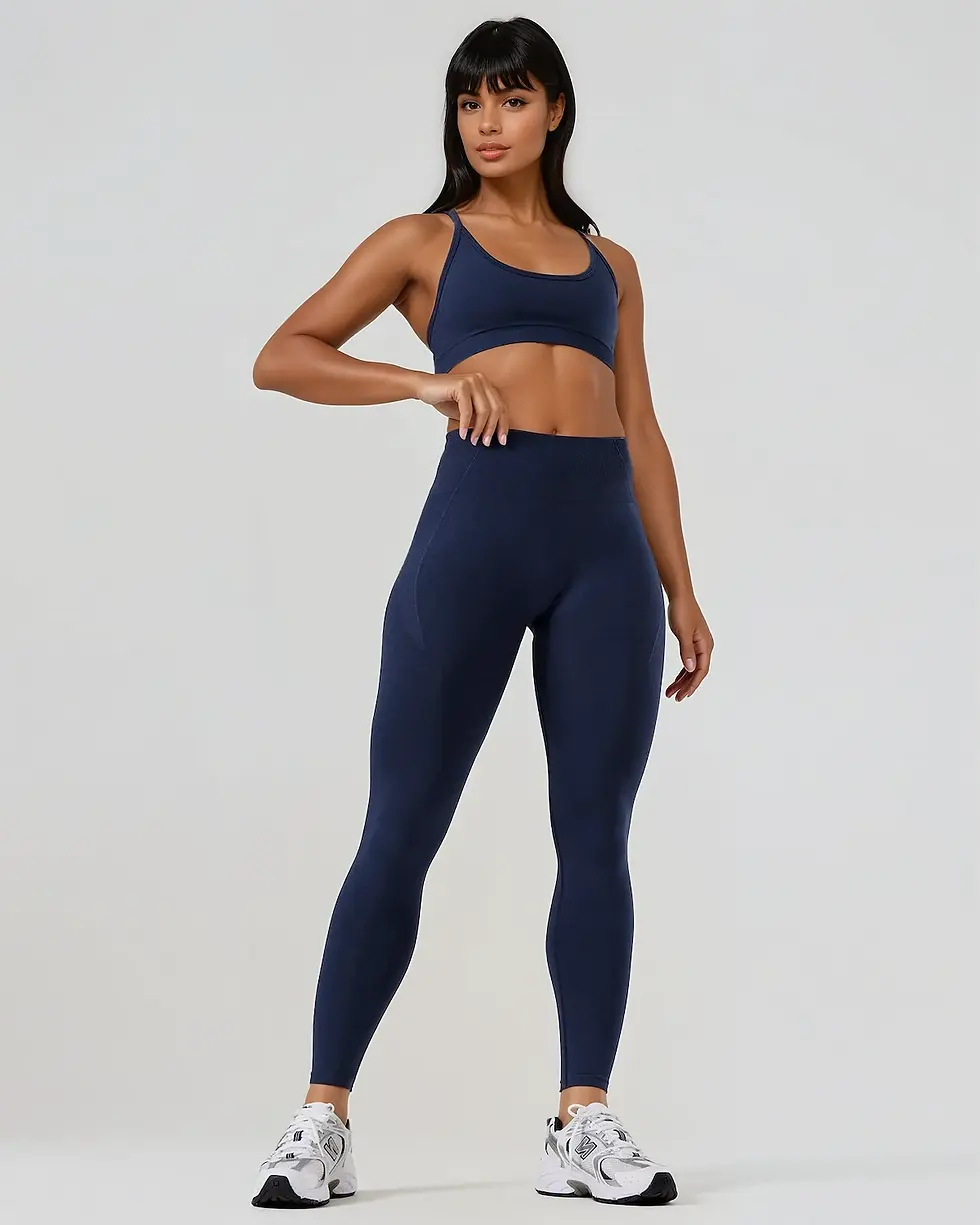
Everyone Wants Premium Sportswear. Few Are Willing to Source It Properly.

Creating a winning sportswear product requires vision, technical discipline and the courage to make the right decisions before they become obvious. It cannot be engineered backwards from the cheapest freight quotation or the smallest possible MOQ.
“Premium quality” may be the most overused phrase in apparel sourcing.
Almost every new brand says it wants premium quality. Many refer to Lululemon, Alo Yoga or another category leader. They want the same hand feel, fit, performance and visual refinement. They want a product that customers immediately recognise as different.
Then the real decisions begin.
During a recent conversation, a prospective customer repeatedly emphasised that premium quality was essential. The benchmark was the type of seamless product associated with leading global sportswear brands.
Based on the product, volume and expected quality, we recommended a specialist seamless production route in Turkey. The immediate concern was freight cost. In this particular programme, the difference in freight represented approximately 1% of the total order value. Yet that 1% began to outweigh decisions affecting almost 100% of the customer’s product experience.
This is one of the most common contradictions in sportswear sourcing:
Brands ask for premium products, but sometimes try to build them using commodity-buying logic.
If a technical product must perform, fit beautifully, survive repeated wear and make customers return for a second purchase and many more the sourcing process cannot begin and end with the cheapest unit price, the lowest MOQ or the shortest freight quotation.
A winning product is created through a chain of connected decisions.
Premium Quality Is Not a Technical Specification
Saying “we want premium quality” is a useful indication of ambition, but it is not enough to develop a product.
What does premium mean for that particular garment?
For a seamless legging, it may mean:
A soft but substantial hand feel
Controlled compression
Reliable elongation, stretch & recovery
Opacity through movement
Body-mapped support
Secure waist construction
Carefully positioned ventilation
Smooth transitions between knitted structures
Consistent measurements across production
Strong colour and wash performance
For a running top, premium may mean something completely different:
Low garment weight
Efficient moisture movement
Rapid drying
Breathability in high-heat areas
Minimal friction
Reflective visibility details
A fabric that does not cling excessively when wet
Seams positioned away from high-movement areas
For an athleisure hoodie, performance may not be the primary consideration at all. The customer may judge its value through fabric density, surface quality, drape, recovery, wash stability, rib construction, silhouette and finishing.
There is no universal premium fabric and no universal premium construction.
A material that is exceptional for yoga may be unsuitable for running. A dense compression fabric may perform beautifully in leggings but feel unpleasant in a lifestyle product. A soft brushed surface may create an attractive first impression while failing the intended abrasion or pilling requirements.
This is why development must begin with the garment’s purpose, not with a fashionable fabric name or a target price copied from another product.
Winning Products Are Built From the Fibre Up
Great products rarely contain one dramatic feature that explains their success.
Their quality comes from hundreds of decisions that work together.
It begins with fibre and yarn selection. Polyamide, polyester, elastane, cotton, modal and recycled alternatives all behave differently. Even within the same fibre family, yarn quality, filament structure, knitting method and finishing can significantly change the result.
The process continues through:
Fabric or knitted structure
Weight and density
Stretch direction
Elastane percentage
Recovery performance
Compression level
Breathability
Moisture management
Opacity
Pilling and abrasion resistance
Colour fastness
Shrinkage and twisting
Pattern and fit
Seam construction
Thread selection
Elastics and supporting components
Logo application
Washing and finishing
Labels, trims and packaging
Customers may never consciously identify each of these details.
They will still feel their combined effect.
They notice when leggings stay in position throughout a workout. They notice when a T-shirt falls cleanly across the body. They notice when a waistband rolls, a light colour becomes transparent, a seam creates friction or a fabric loses its shape.
The details that customers cannot name are often the details that separate an average product from a winning one.
MOQ and Freight Matter, but They Cannot Lead the Product
MOQ, freight and target cost are real commercial considerations. Ignoring them would not be visionary; it would simply be poor business.
But there is an important difference between considering commercial limits and allowing them to dictate every product decision.
A brand may want a specialist material but order too little to meet the mill’s dyeing minimum. It may want six independent colours while dividing a modest order across multiple styles. It may want a custom yarn, unique knitting structure, specially developed trims and complex packaging while expecting the economics of a stock garment.
These conflicts need to be resolved honestly.
Sometimes we can coordinate shared fabrics across related styles. Sometimes colourways can be consolidated. A stock yarn may be more sensible than a custom-developed alternative. Another production country or manufacturing technique may provide a better commercial balance.
But sometimes the correct answer is that the product requires a larger commitment.
A premium product does not become commercially realistic simply because a buyer wants a lower MOQ.
Likewise, choosing the wrong manufacturer to reduce freight by approximately 1% can expose the whole order to much larger risks. Saving a small amount in logistics has little value if the finished product suffers from inconsistent sizing, poor recovery, weak opacity, repeated sample failures or an unacceptable bulk result.
Freight should be optimised after the correct production route has been identified.
It should not decide which factory is technically capable of making the product.
The Cheapest Quotation Is Not Always the Lowest Cost
Garment quotations are easy to compare when they are reduced to a single number.
The real cost of a product is more complex.
It can include:
Development and sampling
Repeated sample corrections
Testing
Packaging
Freight
Duties and taxes
Inspection
Delays
Quality claims
Rework
Customer returns
Markdown
Unsold stock
Lost launch dates
Damage to brand reputation
A quotation that is €1 lower can quickly become the more expensive option if it requires additional sample rounds, creates inconsistent bulk production or produces a garment customers do not want to buy again.
For an emerging brand, the greatest risk is often not paying slightly more for the right product.
The greater risk is spending the entire available budget on the wrong one.
The first collection establishes what customers believe about the brand. Marketing may generate the first purchase, but the product determines whether the customer returns.
A beautiful campaign cannot permanently compensate for an average garment.
The Right Production Country Depends on the Product
Sportswear sourcing should not be reduced to a competition between countries.
Turkey, India, Egypt and Albania each have different strengths, supplier ecosystems, commercial structures and production profiles. Within every country, individual factories also vary enormously.
India may be highly competitive for one category, volume or construction. Turkey may be the stronger choice for another technical product, particularly when specialised seamless knowledge, responsive development, premium materials or closer access to European markets is required.
Egypt can offer a compelling route for larger-volume programmes and selected cotton-based products. Albania may be suitable for particular European nearshoring programmes and categories.
The correct question is not:
“Which country is cheapest?”
The correct question is:
“Which production route gives this product the strongest balance of technical capability, quality, risk, volume, lead time and landed cost?”
At AEM Textile, we do not try to force every collection into one country or one factory.
A seamless legging, technical running top, heavyweight lifestyle hoodie and swimwear product may require completely different manufacturing expertise. Building the supply chain around the collection allows each product to be placed with the most appropriate specialist.
The brand still works with one central team while we coordinate the different technical and production partners behind the programme.
Premium Product Development Requires Commercial Courage
New founders are often told to reduce every risk.
Order fewer pieces. Develop fewer products. Avoid commitment. Choose the cheapest available supplier. Minimise sampling. Delay testing. Use whatever material is immediately available.
Some caution is necessary, especially in a first collection.
But removing every visible risk can also remove the conditions required to create something meaningful.
There is no completely risk-free way to build a successful sportswear brand.
Creating a differentiated product requires decisions before the sales data exists. A founder must choose a fit direction, invest in development, commit to a material, approve colours and place a production order before the market gives a final answer.
That requires judgement and courage.
The answer is not reckless spending or an unnecessarily large collection. The answer is a controlled commitment supported by a clear product strategy.
A strong first collection does not need to be enormous. It does, however, need enough structure to present the brand properly, build complete looks and give customers a reason to choose it.
Launching one generic legging simply because it carries the lowest MOQ may feel safe. Commercially, it may be far riskier than launching a focused collection with a recognisable identity and a coherent use case.
Courage does not mean ignoring the numbers.
It means understanding which numbers matter most.
Certification Does Not Replace Product Engineering
Certifications can be essential depending on the product, market and claims being made.
Standards relating to chemical safety, recycled content, organic fibres, environmental management and social compliance may all form part of the sourcing decision.
However, a certification does not automatically make a garment premium.
A certified fabric can still be unsuitable for its intended use. It may have insufficient recovery, poor opacity, the wrong surface, an inappropriate weight or an uncomfortable performance profile.
Likewise, the certification of a material, factory or process should not automatically be presented as certification of the entire finished product. The exact scope and chain of custody must be verified before making customer-facing claims.
At AEM Textile, certification requirements are considered alongside technical performance, manufacturing capability, commercial volume and the intended use of the product.
The objective is not to collect logos for a presentation.
It is to build a responsible, traceable and technically appropriate product.
What Serious Brands Should Ask Their Manufacturing Partner
Price and MOQ should always be discussed. But they should not be the only questions.
A professionally planned brand should also ask:
Why is this material suitable for the product?
What are its technical limits?
How will it behave during movement and repeated washing?
Is its recovery appropriate for the required compression?
How will opacity be evaluated?
Which tests are relevant to the intended use?
Can the proposed factory control this construction consistently?
Are the colour and material minimums compatible with the collection plan?
What does the certification actually cover?
Which details create the greatest production risk?
Which decisions could be simplified without weakening the product?
Is the recommended production country genuinely the best route for this category?
A good manufacturing partner should be able to explain the reasoning behind its recommendations.
Sometimes that means supporting the customer’s original direction.
Sometimes it means challenging it.
The purpose is not to win every argument. It is to protect the final product.
How AEM Textile Approaches Premium Sportswear Development
AEM Textile works as an external product development and manufacturing partner for sportswear, activewear, athleisure, seamless and swimwear collections.
We begin by understanding the product’s intended use, target customer, desired retail position, technical requirements, commercial volume and destination market.
From there, we connect the main decisions:
Product purpose → material → construction → fit → testing → MOQ → production partner → country → landed cost
This sequence matters.
Starting with the cheapest factory and attempting to force the desired product into its existing capabilities usually creates compromises later. These compromises appear as changing fabrics, repeated samples, inconsistent quality or a final product that no longer reflects the original vision.
Our role is to identify those conflicts earlier.
We guide brands through material selection, colour coordination, trims, branding, technical development, sampling, pre-production approval and bulk manufacturing. When different products require different specialists, we manage the programme through our production network in Turkey, Egypt, Albania and India.
This gives the customer one central team instead of a fragmented chain of unrelated suppliers.
It does not make every production challenge disappear.
It makes those challenges visible, manageable and easier to resolve before they become expensive.
A Winning Product Cannot Be Built Around the Smallest Number
A winning sportswear product demands more than a mood board, a logo and the repeated use of the word “premium.”
It requires a clear purpose, an understanding of the customer and a disciplined series of decisions from fibre selection to the smallest finishing detail.
MOQ matters.
Freight matters.
Price matters.
But none of them can compensate for choosing the wrong material, the wrong construction or the wrong manufacturing partner.
If a freight difference representing approximately 1% of an order determines where a highly technical product is manufactured, premium quality was never the real priority.
Price was.
The brands with the greatest chance of success are not necessarily those with unlimited budgets. They are the brands that know where to invest, where to simplify and where refusing to compromise protects the entire business.
That is the real courage required to build a winning product.
If you are planning a sportswear, activewear, athleisure, seamless or swimwear collection and want to evaluate it as a complete technical and commercial programme, contact AEM Textile.
Let us build the product properly, from the first fibre to the final detail.